Archive for the ‘Hospitals’ Category

ONC and CMS @HIMSS12 Annual Conference & Exhibition — Las Vegas

Saturday, February 18th, 2012

Federals at HIMSS12 Annual Conference & Exhibition
February 20-24, 2012 · Las Vegas, NV
Accessed and excerpted from HealthIT.gov on Feb 18, 2012

Representatives from ONC, Centers for Medicare & Medicaid Services (CMS), Office for Civil Rights (OCR), and other Federal agencies will be at HIMSS to share information about their health IT initiatives. Below are highlights from the HIMSS schedule of events. For a complete list of participating Federal agencies and their educational sessions, visit the Federal section of the HIMSS12 website.

HIMSS Schedule of Events

Time Location Event
Monday, February 20, 2012
8:45-9:30 a.m. Lando 4204 HIE Symposium – Opening Keynote HIE: The Next Generation and Beyond
Doug Fridsma, Director, Office of Standards and Interoperability
9:30-10:30 a.m. Lando 4204 HIE Symposium – Inter Agency Collaboration: A Federal Update
John Allison, Health Insurance Specialist
Claudia Williams, Director, State HIE Program
10:45-11:45 a.m. Lando 4204 HIE Symposium – State Collaborations: Current Trends and Future Directions
Lee Stevens, Program Manager, State HIE Program
11 a.m.-12 p.m. San Paolo 3504 Physicians’ IT Symposium – Optimizing Your EHR Value Through Patient Engagement
Judy Murphy, RN, Deputy National Coordinator
12:45-1:45 p.m. Lando 4204 HIE Symposium – SLHIE: Moving from Planning to Implementation
Jessica Kahn, Technical Director for Health IT
Claudia Williams, Director, State HIE Program
1-2 p.m. Veronese 2506 Achieving Meaningful Use Symposium – CMS and ONC Present Stage 2 Essential Knowledge
Robert Anthony, Policy Analyst, CMS
Steven Posnack, Director, Federal Policy Division, ONC
1:30-2:30 p.m. Veronese 2406 Performance Measurement and CDS Symposium: Leveraging CDS at the Point of Care to Optimize Quality Measure Outcomes
Jacob Reider, MD, ONC Senior Policy Advisor
Tuesday, February 21, 2012
9:45-10:45 a.m. Casanova 503 Health IT Update from HRSA
Yael Harris, PhD, MHS, Director, Office of Health IT & Quality
9:45-10:45 a.m. Lando 4303 Stage 2 Meaningful Use
Elizabeth Holland, Director, HIT Initiatives Group
Jessica Kahn, Technical Director for Health IT
9:45-10:45 a.m. Galileo 1001 Direct Project Panel Discussion
Moderator: Doug Fridsma, Director, Office of Standards and Interoperability
9:45-10:45 a.m. TBD HIE National Landscape, Monitoring States Momentum
Moderator: Lee Stevens, Program Manager, State HIE Program
11:00 a.m.-12:00 p.m. Casanova 503 CDC and Meaningful Use: Strengthening the Link Between Healthcare Providers and Public Health
Seth Foldy, MD, MPH, FAAFP, Senior Advisor, Public Health Surveillance & Informatics Program Office
11:00 a.m.-12:00 p.m. Lando 4303 ONC Consumer Outreach/Pledge Initiative
Lygeia Ricciardi, Senior Policy Advisor for Consumer e-Health
11:00 a.m.-12:00 p.m. San Polo 3503 Medicare and Medicaid EHR Incentive Programs: Meaningful Use Stage 1 Overview
Travis Broome, Policy Analyst
Elizabeth Holland, Director, HIT Initiatives Group
Jessica Kahn, Technical Director for Health IT
Robert Anthony, Policy Analyst
12:15-1:15 p.m. San Polo 3503 Redefining Health Care: Advancing Patient-Centered Care Through Health IT
Carolyn Clancy, MD, Director of AHRQ
Wednesday, February 22, 2012
8:30-9:30 a.m. San Polo 3503 ONC Certification Programs – Update and Next Steps
Doug Fridsma, Director, Office of Standards and Interoperability
Steve Posnack, Director, Federal Policy Division
Carol Bean, Director, Certification Division
9:45-10:45 a.m. San Polo 3503 Stage 2 Meaningful Use: An Introduction
Travis Broome, Policy Analyst, CMS
Elizabeth Holland, Director, HIT Initiatives Group, CMS
Steve Posnack, Director, Federal Policy Division, ONC
Farzad Mostashari, MD, ScM, National Coordinator for Health Information Technology
1-2 p.m. Casanova 503 Update on HIPAA Initiatives
David Sayen, Regional Administrator, CMS
Elizabeth Reed, Health Insurance Specialist, CMS
2:15-3:45 p.m. San Polo 3503 ONC Townhall: Advancing Health IT Into the Future
Farzad Mostashari, MD, ScM, National Coordinator for Health Information Technology
Thursday, February 23, 2012
8:30-9:30 a.m. Palazzo Ballroom Keynote speaker
Farzad Mostashari, MD, ScM, National Coordinator for Health Information Technology
9:45-10:45 a.m. San Polo 3503 Privacy and Security – You Can Do It and Here’s How
Joy Pritts, Chief Privacy Officer, ONC
9:45-10:45 a.m. Venetian Showroom Medicare and Medicaid EHR Incentive Programs: Stage 2 NPRM Overview
Travis Broome, Policy Analyst, CMS
Elizabeth Holland, Director, HIT Initiatives Group, CMS
Jessica Kahn, Technical Director for Health IT, CMS
Robert Anthony, Policy Analyst, CMS
1-2 p.m. TBD RECs: Accelerating Meaningful Use
Kimberly Lynch, Director of the REC Program
1-2 p.m. Lido 3106 Stage 2: Exchange of Information and Public Health Objectives
Jessica Kahn, Technical Director for Health IT, CMS
Robert Anthony, Policy Analyst, CMS
Steven Posnack, Director, Federal Policy Division, ONC
1-2 p.m. Murano 3306 Consumer E-Technology in Action: Four Implementation Examples from Beacon Communities
Korey Capozza, Utah Beacon
Drew McNicol, Western New York Beacon
Alan Snell, MD, Indiana Beacon
Barbara Sorondo, Maine Beacon
2:15-3:15 p.m. Marco Polo 705 IOM Study-Patient Safety
Jacob Reider, MD, ONC Senior Policy Advisor
2:15-4:15 p.m. San Polo 3503 Stage 2: Clinical Quality Measures
Travis Broome, Policy Analyst, CMS
Steve Posnack, Director, Federal Policy Division, ONC
Friday, February 24, 2012
10:00-11:00 a.m. San Polo 3503 HIPAA Privacy and Security Regulations
Leon Rodriguez, Director of OCR
11:15 a.m.-12:15 p.m. Venetian Showroom Stage 2: Payment Adjustments and Changes from Stage 1
Travis Broome, Policy Analyst, CMS
Robert Anthony, Policy Analyst, CMS
Theater Booth Sessions – Exhibit Hall, Booths 14624/14824

CMS and ONC will be presenting on special topics in health IT and meaningful use at the theater booth in the HIMSS exhibit hall.

Time Presentation Topic
Tuesday, February 21, 2012
1:30-2:15 p.m. Workforce: The Use of Immersive Learning Environments in Online HIT Technology
3:00-3:30 p.m. Medicaid Patient Volume
4:00-5:45 p.m. Beacon Communities: Bringing HITECH to Life – Beacon Project Highlights – IT-Enabled Care Coordination, HIT Infrastructure to Support Pioneer ACOs, and Mobile Technology in Support of Better Diabetes Management
Wednesday, February 22, 2012
9:45-10:30 a.m. Query Health: Demonstrating How to Send Questions to the Data
11:00-11:30 a.m. Overview and Timeline for Incentives and Payment Adjustments
12:00-12:45 p.m. NwHN Exchange Opportunities and the Path Forward
2:45-3:30 p.m. AHRQ: Model Children’s EHR Format
4:00-4:30 p.m. FAQs on Stage 1 Meaningful Use
5:00-5:45 p.m. The popHealth Challenge Demonstration: Patient Engagement Reminders for popHealth Measures
Thursday, February 23, 2012
10:00-10:30 a.m. How States Are Auditing the Medicaid EHR Incentive Programs
11:30 a.m.-12:00 p.m. Overview of Stage 2 Meaningful Use
3:00-3:45 p.m. Privacy & Security: Privacy Protection for Substance Abuse Treatment Information
4:00-4:45 p.m. Workforce: Using the ONC-HIT Teaching Materials
ONC “Talk to the Expert” Sessions – Exhibit Booth #14824

ONC will be hosting “Talk to the Expert” sessions at its exhibit booth. Stop by to learn about:

  • ONC resources
  • Certification and Standards/Interoperability
  • ONC’s Regional Extension Centers, Beacon, and Workforce programs.
Engage with ONC during the Conference Online

During HIMSS, ONC will be engaging people online through its social media properties by:

  • Hosting discussions on LinkedIn
  • Tweeting live from the event
  • Loading all of their handouts from the conference on Scribd

If you are not already a member of our LinkedIn group, or following us on Twitter (@ONC_HealthIT), sign up today to join the discussion!

Don’t forget to check out Scribd to download handouts from HIMSS!

For More Information

ONC Appoints Muntz and Murphy in Reorg

Monday, January 16th, 2012

Experienced Health IT Execs Appointed to Lead in 2012
National Coordinator for Health IT Farzad Mostishari, MD, ScM,  appointed David Muntz, MBA, to the new position of Principal Deputy National Coordinator in the Office of the National Coordinator for Health IT in January 2012, while Judy Murphy, RN, FACMI, FHIMSS, FAAN, was appointed Deputy National Coordinator for Programs and Policy in late 2011. Both the positions and appointees have been posted recently on the ONC’s Web site.

David Muntz, MBA, FCHIME, CHCIO
Principal Deputy National Coordinator

David Muntz, FCHIME, CHCIO

David Muntz, FCHIME, CHCIO

Muntz was  Senior Vice President and Chief Information Officer for the Baylor Health Care System in Dallas and a 38-year veteran of medical information systems. According to the ONC Description of Organizational Structure and Offices, the “Principal Deputy National Coordinator works with and reports directly to the National Coordinator and is responsible for day-to-day operations, decision making, and staff management of ONC. The Principal Deputy will oversee the activities of four offices within ONC: Office of the Deputy National Coordinator for Programs and Policy; Office of the Deputy National Coordinator for Operations; Office of Economic Analysis, Evaluation and Modeling; and, Office of the Chief Scientist. One of the current ONC offices, the Office of the Chief Privacy Officer, is a position mandated by the American Recovery and Reinvestment Act of 2009, and will continue to report to the National Coordinator.”

According to a press release issued in conjunction with 2010 National Health IT Week,  “David Muntz, a 37-year veteran of Medical Information Systems, is Senior Vice President and Chief Information Officer for the Baylor Health Care System in Dallas. As CIO, Mr. Muntz is responsible for more than 650 employees who care for a delivery system with more than 140 points of entry. Mr. Muntz works closely with hospitals, leadership, boards, physicians, nurses and clinicians system-wide toward improving information technology at Baylor. Since he joined Baylor in 2006, the hospital has received notoriety in healthcare IT, most notably as the #1 innovator in the healthcare sector on the 2007 Information Week 500 list.

“Mr. Muntz is a Fellow of the College of Healthcare Information Management Executives (CHIME) and currently serves on the CHIME Board of Trustees, Advocacy Leadership Team, and Policy Steering Committee. Also an active member of the Health Information and Management Systems Society (HIMSS), he has been a speaker for  numerous local, state, and national organizations. He was recognized as CIO Innovator of the Year by CHIME in 2005 and was listed as one of the “Top 5 CIOs” in the June 1999 issue of Health Management.

“Prior to Baylor, Mr. Muntz most recently served as the Senior Vice President and CIO at Texas HealthResources, where he was responsible for all information system functions including Medical Records. While working for Texas Health Resources, Muntz’s information services organization received national recognition nine years in a row. Mr. Muntz also had a distinguished career with the Wadley Research Institute and Blood Bank, starting as a biostatistician and eventually becoming CEO of the Institute. During his tenure with Wadley, Mr. Muntz led the team that created a complete online record for the community’s blood bank. In addition, Wadley’s other divisions, the hospital, clinic,
and physician practices, shared a computer based patient record created by Mr. Muntz and his staff.

“Mr. Muntz holds an MBA from Southern Methodist University in Dallas and an AB degree in Premedicine and English from Columbia College in New York City.”

Judy Murphy, RN, FACMI, FHIMSS, FAAN
Deputy National Coordinator for Programs and Policy

Judy Murphy, RN, FACMI, FHIMSS, FAAN

Judy Murphy, RN, FACMI, FHIMSS, FAAN

According to the ONC Web site,Judy Murphy is Deputy National Coordinator for Programs & Policy at the Office of the National Coordinator for Health IT, Department of Health and Human Services in Washington D.C.  She is a nurse, who came to the ONC in December of 2011 with more than 25 years of health informatics experience at Aurora Health Care in Wisconsin, an integrated delivery network with 15 hospitals, 120 ambulatory centers, home health agencies and over 30,000 employees.  She led the EHR program since 1995, when Aurora was one of the early adopters of health IT.  Most recently she was Vice President-EHR Applications, and managed the organization’s successful achievement of Stage 1 EHR Meaningful, with incentive payments beginning in September 2011.

“Her informatics interests lie in system implementation methodologies, health IT project management, automated clinical documentation, and the use of technology to support evidence-based practice; she has published and lectured nationally and internationally on these topics.  She has a long-standing reputation of patient advocacy and maintaining a “patient-centric” point of view, and approaches her work with unyielding energy as well as dedication, passion, and commitment to the healthcare transformation enabled by technology.

“Judy has been on the Health IT Standards Committee since its inception in May 2009.  On that committee, she co-chaired the Implementation Workgroup, and was a member of the Meaningful Use Workgroup.  She has also served on the American Medical Informatics Association (AMIA) Board of Directors and the Health Information and Management Systems Society (HIMSS) Board of Directors.  She is a Fellow in the American Academy of Nursing, the American College of Medical Informatics and HIMSS.  She received the 2006 HIMSS Nursing Informatics Leadership Award, was named one of the “20 People Who Make Healthcare Better” in 2007 by HealthLeaders magazine, and was selected as one of 33 Nursing Informatics’ Pioneers to participate in the Nursing Informatics History Project sponsored by AMIA, NLM, AAN, and RWJF.”

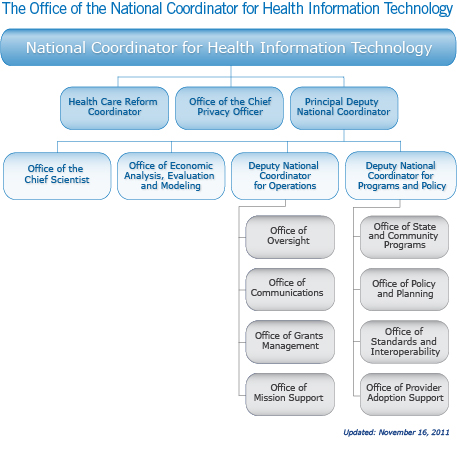
ONC Organization Chart
ONC Posts New Organizational Chart Dated Nov 16, 2011.

Description of Organizational Structure and Offices

The Office of the National Coordinator for Health Information Technology (ONC) is directed by the National Coordinator and is assisted by the Chief Privacy Officer, Health Care Reform Coordinator, and Principal Deputy National Coordinator as well as the Deputy National Coordinator for Operations, Deputy National Coordinator for Programs & Policy, Chief Scientist, and the Office of Economic Analysis, Evaluation and Modeling.

The Office of the Chief Privacy Officer, a position mandated by the Recovery Act, advises on privacy, security, and data stewardship of electronic health information and coordinate ONC’s privacy and related efforts with similar privacy officers in other Federal agencies, State and regional agencies, and foreign countries.

Health Care Reform Coordinator is the principal advisor to the National Coordinator for all Health Reform issues. The coordinator ensures the programs to accelerate adoption of interoperable health IT lay the necessary foundation for health care reform including new payment policy that achieves better care, better health, and lower costs.

Principal Deputy National Coordinator works with and reports directly to the National Coordinator and is responsible for day-to-day operations, decision making, and staff management of ONC. The Principal Deputy will oversee the activities of four offices within ONC: Office of the Deputy National Coordinator for Programs and Policy; Office of the Deputy National Coordinator for Operations; Office of Economic Analysis, Evaluation and Modeling; and, Office of the Chief Scientist. One of the current ONC offices, the Office of the Chief Privacy Officer, is a position mandated by the American Recovery and Reinvestment Act of 2009, and will continue to report to the National Coordinator.

The Office of Economic Analysis and Modeling provides analyses to the National Coordinator, including advanced modeling of the U.S. health care system for simulating the micro- and macroeconomic effects of investing in health IT.

The Office of the Chief Scientist is responsible for research and for identifying innovations in information technology that can be applied in health care settings, and which will be the ONC interface for international activities.

The Office of the Deputy National Coordinator for Programs and Policy assumes functions previously performed by the Office of Health Information Technology Adoption, the Office of Interoperability and Standards, the Office of Adoption Provider Support, the Office of State and Community Programs, and the Office of Policy and Planning. The new office will lead ONC programs related to health information exchange, regional extension centers, training of the health IT workforce, and the development of technical standards for interoperability, security, and certification of health IT systems. The new office comprises:

  • The Office of Standards and Interoperability, with responsibility for standards, security, certification, the Nationwide Health Information Network, Federal Health Architecture and the CONNECT program;
  • The Office of Provider Adoption Support, which administers the Regional Extension Centers program and health IT workforce development;
  • The Office of State and Community Programs, which administers the state-level health information exchange program and the Beacon Communities Program; and
  • The Office of Policy and Planning, which is realigned to include all policy development, including privacy and security policy, and is liaison with legal affairs and legislative affairs, regulations development and externally focused strategic planning.

Deputy National Coordinator for Operations is responsible for activities that are vital to supporting ONC’s numerous programs and enhancing ONC’s ability to communication about health IT. This office comprises:

  • The Office of Communications, which is responsible for stakeholder communications and constituency relations; and
  • The Office of Mission Support, which supports day-to-day operations, including new grants processing, contracts management, budget execution and reporting, human resources, as well as internal strategic planning, special projects, and budget formulation; and
  • The Office of Oversight, which assures oversight of grants, internal and external performance reporting, and auditing; and
  • The Office of Grants Management, which is responsible for carrying out full lifecycle grants management functions and providing procedural and technical business support to ONC grant award recipients and program managers. The office is charged with awarding and managing ONC’s portfolio of grant programs. Through the execution of the grants lifecycle, the office ensures that federal grant funds are properly awarded and are managed effectively to ensure good stewardship of taxpayer dollars.

DIRECTORY as of 1/9/2012
Farzad Mostashari, MD, ScM

National Coordinator for Health Information Technology

Office of the Chief Privacy Officer
Joy Pritts, JD
Principal Deputy National Coordinator
David Muntz, MBA
Deputy National Coordinator for Programs and Policy
Judy Murphy, RN, FACMI, FHIMSS, FAAN

Deputy National Coordinator for Operations
Elisabeth A. Handley, MPA
  • Office of Oversight: Maruta Budetti
  • Office of Communications: Peter Garrett
  • Office of Grants Management: Lisa Lewis
  • Office of Mission Support: Sam Shellenberger
Office of the Chief Scientist
Doug Fridsma, M.D., Ph.D. (Acting)
Office of Economic Analysis and Modeling
Mike Furukawa, Ph.D. (Acting)
Health Care Reform Coordinator
Kelly Cronin

ONC Blogs on multi-EHR certification and other issues

Saturday, June 11th, 2011

Perpetually Perplexed by Regulatory Interpretations? Separate the Fact from Fiction
June 10, 2011, 2:45 pm /Posted by Steven Posnack, Director Federal Policy Division, ONC, on ONC’s Health IT Buzz blog
and republished by e-Healthcare Marketing here.

If enough people believe something, it has to be true, right? In my travels, I’ve found that regulatory interpretations range from being largely factual to wildly fictitious. The latter often results from misinterpretations of regulatory language, improper combinations of regulatory language from different rules, or accurate interpretations getting lost in translation as they are passed from person-to-person. These inaccurate interpretations, intentional or not, often unsurprisingly lead to confusion. Accordingly, I thought it would be helpful to clear up a few things I’ve heard related to certification.

  • Statement 1: If an eligible professional or eligible hospital combines multiple certified electronic health record (EHR) Modules together (or a certified EHR Module[s] with a certified Complete EHR), that combination also needs to be separately certified in order for it to meet the definition of Certified EHR Technology – *FICTION*
    • Part 2 of the definition of Certified EHR Technology acknowledges that a combination of certified EHR Modules can be used to meet the definition of Certified EHR Technology.  At 75 FR 2023, we clarified that as long as each EHR Module which makes up the combination has been certified, the definition could be met. See also FAQ 17.
    • Combining certified EHR Modules or certified EHR Modules with a certified Complete EHR (or even two certified Complete EHRs) will not invalidate the certification assigned to the EHR technologies. Each EHR technology retains the certification assigned to it.  Our FAQs (such as #7, #14, and #21) identify cases where combining certified Complete EHRs with other certified EHR Modules could occur without any negative effects.
    • Note, generating the “CMS EHR Certification ID” on ONC’s Certified HIT Products List (CHPL) for meaningful use attestation purposes is different. Using the CHPL, an eligible professional (EP) or eligible hospital (EH) generates a CMS EHR Certification ID (a unique alpha-numeric string) to report to CMS as part of its attestation. The CMS EHR Certification ID represents the combination of certified EHR Modules or other combination of certified EHR technologies that meet the definition of Certified EHR Technology and were used during the meaningful use reporting period.
  • Statement 2: The ONC-Authorized Testing and Certification Bodies (ONC-ATCBs) operate under contract with and receive funding from ONC – *FICTION*
    • ONC-ATCBs do not receive funding from ONC to perform their ONC-ATCB duties.  ONC-ATCBs support their operations through testing and certification fees charged to Complete EHR and EHR Module developers.
    • The Temporary Certification Program Final Rule established certain responsibilities and rules for ONC-ATCBs.  ONC-ATCBs must fulfill these requirements and adhere to the rules in order to maintain good standing under the program. For example, ISO/IEC Guide 65 requires ONC-ATCBs to make their services accessible to all applicants (e.g., EHR developers) whose activities fall within its declared field of operation (e.g., the temporary certification program), including not having any undue financial or other conditions.
  • Statement 3: Testing and certification under the Temporary Certification Program does not examine whether two randomly combined EHR Modules will be compatible or work together – *FACT*
    • ONC-ATCBs are not required to examine the compatibility of two or more EHR Modules with each other.  EHR Module developers, however, are free, and highly encouraged, to work together to ensure that EHR Modules are compatible. 
  • Statement 4: The ONC-ATCBs favor big EHR technology developers – *FICTION*
    • The ONC-ATCBs do not favor large developers, and such favoritism is precluded by the international standards to which ONC-ATCBs must adhere.
    • As of June 3, 2011, 438 EHR technology developers were represented on the CHPL.  Of those, approximately 60 percent are small companies (<51 employees) and approximately 12 percent are large companies (>200 employees).
  • Statement 5: Certification doesn’t require that an EHR technology designed by one EHR developer make its data accessible or “portable” to another EHR technology designed by a different developer – *FACT*
    • We are very interested in exploring future certification requirements to improve data portability.
    • If you have any insights on how to improve data portability between EHR technologies, please feel free to leave a comment below. 
  • Statement 6: As an EP or EH, you need to demonstrate meaningful use in the exact way that EHR technology was tested and certified – *FICTION* (mostly)
    • See the jointly posted ONC and CMS FAQs (#24 or 10473
  • Statement 7: Certifications “expire” every two years – *FICTION*
    • A certification represents a “snapshot.”  It indicates that EHR technology has met specific certification criteria at a fixed point in time. In other words, an EHR technology would not “lose its certification” after a given time period.  If, however, certification requirements change (e.g., new and/or revised certification criteria are adopted), the snapshot the certification represents would no longer accurately reflect that the EHR technology meets the changed requirements.
    • In our certification program rules, we indicated that we anticipated adopting new and/or revised certification criteria every two years to coincide with changes to the meaningful use objectives and measures under the Medicare and Medicaid EHR Incentive Programs. We did not, however, set a specific expiration for certifications.  Rather, we explained that once the Secretary adopts new and/or revised certification criteria, EHR technology may need to be tested and certified again. In other words, the previously taken snapshot would no longer accurately represent what is required to meet the adopted certification criteria and, thus, would no longer be sufficient to support an EP or EH’s ability to achieve updated meaningful use requirements.
    • For more information about the validity of a certification, please refer to the Temporary Certification Program final rule (75 FR 36188) and the Permanent Certification Program final rule (76 FR 1301).

As someone who has played a roll in drafting all of ONC’s regulations, I take pride in making our rules readily understandable and as easy to read as possible. Sometimes, though, no matter how hard we try to convey a regulation’s intent, there is always another believable interpretation. Hopefully, this blog helps clear up a few points and furthers your personal understanding of our rules.
###
To post comments directly on ONC’s Health IT Buzz blog post, click here.

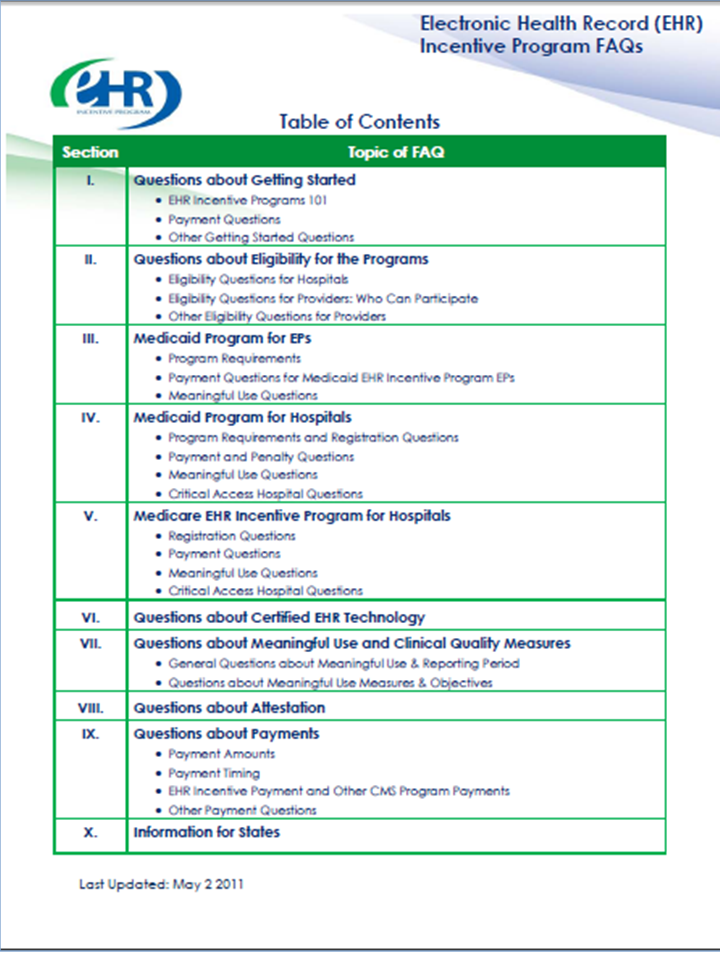
CMS Publishes PDF of EHR Incentive Program FAQs: 85 Pages, May 2

Sunday, May 15th, 2011

85 Pages of FAQs for EHR Incentive Program (pdf)
Click here for PDF version updated on May 2, 2011

Since May 2 PDF, some FAQs have updated electronically on CMS Web site, and links to online FAQs are below.

CMS FAQs: EHR Incentive Payments Program

CMS FAQs


Leading FAQs: When’s the money coming for Eligible Professionals under the Medicare Program?
Medicaid Programs are rolling out on state-by-state basis.

Excerpted on May 14, 2011:
For the 2011 payment year, how and when will incentive payments be made to Eligible Professionals?

Published 10/18/2010 10:36 AM   |    Updated 04/26/2011 05:42 PM   |    Answer ID 10160

For the 2011 payment year, how and when will incentive payments for the Medicare Electronic Health Record (EHR) Incentive Programs be made?

For eligible professionals (EPs), incentive payments for the Medicare EHR Incentive Program will be made approximately four to eight weeks after an EP successfully attests that they have demonstrated meaningful use of certified EHR technology. However, EPs will not receive incentive payments within that timeframe if they have not yet met the threshold for allowed charges for covered professional services furnished by the EP during the year. Payments will be held until the EP meets the $24,000 threshold in allowed charges for calendar year 2011 in order to maximize the amount of the EHR incentive payment they receive. If the EP has not met the $24,000 threshold in allowed charges by the end of calendar year 2011, CMS expects to issue an incentive payment for the EP in March 2012 (allowing 60 days after the end of the 2011 calendar year for all pending claims to be processed). Payments to Medicare EPs will be made to the taxpayer identification number (TIN) selected at the time of registration, through the same channels their claims payments are made. The form of payment (electronic funds transfer or check) will be the same as claims payments.

Bonus payments for EPs who practice predominantly in a geographic Health Professional Shortage Area (HPSA) will be made as separate lump-sum payments no later than 120 days after the end of the calendar year for which the EP was eligible for the bonus payment.

Please note that the 90-day reporting period an EP selects does not affect the amount of the EHR incentive payments. The Medicare EHR incentive payments to EPs are based on 75% of the estimated allowed charges for covered professional services furnished by the EP during the entire payment year. If the EP has not met the $24,000 threshold in allowed charges at the time of attestation, CMS will hold the incentive payment until the EP meets the threshold as described above.

Medicare EHR incentive payments to eligible hospitals and critical access hospitals (CAHs) will also be made approximately four to eight weeks after the eligible hospital or CAH successfully attests to having demonstrated meaningful use of certified EHR technology. Eligible hospitals and CAHs will receive an initial payment and a final payment. Eligible hospitals and CAHs that attest in April can receive their initial payment as early as May 2011. Final payment will be determined at the time of settling the hospital cost report.

Please note that the Medicaid incentives will be paid by the States, but the timing will vary according to State. Please contact your State Medicaid Agency for more details about payment.

When will CMS begin to pay incentives to EPs, eligible hospitals, and CAHs for using certified…..

Published 08/13/2010 04:12 PM   |    Updated 04/18/2011 11:14 AM   |    Answer ID 10066

When will the Centers for Medicare & Medicaid Services (CMS) begin to pay incentives to eligible professionals (EPs) and eligible hospitals and critical access hospitals (CAHs) for using certified electronic health record (EHR) technology?

Payments for the Medicare EHR Incentive Program are expected to be available as early as May 2011. Attestation for the Medicare EHR Incentive Program opened on April 18, 2011. Registration for the Medicare EHR Incentive Program began on January 3, 2011 and is available online at https://ehrincentives.cms.gov. Please note that although the Medicaid EHR Incentive Programs began January 3, 2011, not all states are ready to participate at this time. Information on when registration will be available for Medicaid EHR Incentive Programs in specific States is posted at http://www.cms.gov/EHRIncentivePrograms/40_MedicaidStateInfo.asp.

For more information about the Medicare and Medicaid EHR Incentive Program, please visit: http://www.cms.hhs.gov/EHRIncentivePrograms.

Online FAQs for CMS EHR Incentive Program

All EHR Incentive Program FAQs

8 of 10 Hospitals, 4 of 10 Physicians Plan to Adopt Electronic Health Records; Reversal of Trends

Thursday, January 13th, 2011

Surveys show significant proportions of hospitals and doctors already plan to adopt electronic health records and qualify for federal incentive payments
2/3 of Hospitals Plan to Enroll During Stage 1, 2011-2012
HHS Press Release
Thursday, January 13, 2010

Four-fifths of the nation’s hospitals, and 41 percent of office-based physicians, currently intend to take advantage of federal incentive payments for adoption and meaningful use of certified electronic health records (EHR) technology, according to survey data released today by the Office of the National Coordinator for Health Information Technology (ONC).  The survey information was released as the registration period opened for the Medicare and Medicaid EHR Incentive Programs.

David Blumenthal, M.D., M.P.P., the National Coordinator for Health Information Technology, said the survey numbers represent a reversal of the low interest in EHR adoption in previous years.  He credited leadership from the medical community and the federal government for the improved prospects for adoption and use of health information technology (health IT).

“For years we have known that electronic health records would improve care for patients and bring about greater cost effectiveness in our health sector, yet adoption rates by health care providers remained low,” Dr. Blumenthal said.  “In 2009, Congress and the President authorized major new federal support for EHR adoption and use, and in combination with medical professional and hospital leadership. I believe we are seeing the tide turn toward widespread and accelerating adoption and use of health IT.”

The data released today comes from surveys commissioned by ONC and carried out in the course of regular annual surveillance by the American Hospital Association (AHA) and the National Center for Health Statistics (NCHS), an agency of HHS’ Centers for Disease Control and Prevention (CDC).

The AHA survey found that 81 percent of hospitals plan to achieve meaningful use of EHRs and take advantage of incentive payments.  About two-thirds of hospitals (65 percent) responded that they will enroll during Stage 1 of the Incentive Programs, in 2011-2012.

The NCHS survey found that 41 percent of office-based physicians are currently planning to achieve meaningful use of certified EHR technology and take advantage of the incentive payments.  Four-fifths of these, or about a third of all office-based physicians (32.4 percent), responded that they will enroll during Stage 1 of the programs.  Only 14 percent of respondents said they were not planning to apply for meaningful use incentives.

Additional survey data from NCHS show that significantly increasing numbers of primary care physicians have already adopted a basic EHR, rising by 50 percent from 19.8 percent of primary care physicians in 2008 to 29.6 percent in 2010.  Basic EHRs provide a beginning point for use of electronic health records in physician offices, but most physicians would need to further upgrade their EHR systems or their use of the systems in order to qualify for meaningful use incentive payments.

Incentive payments for the adoption and meaningful use of certified EHR technology were authorized in the Health Information Technology Economic and Clinical Health Act (HITECH) in 2009.   Incentive payments will be made through the Medicare and Medicaid programs.  High rates of adoption and meaningful use could result in as much as $27 billion in incentive payments over 10 years.

Non-hospital-based physicians and other eligible professionals can obtain incentive payments of as much as $44,000 under Medicare or $63,750 under Medicaid.  Under both Medicare and Medicaid, eligible hospitals may receive millions of dollars for implementing and meaningfully using certified EHR technology.

Provider registration for the Medicare EHR Incentive Program and some Medicaid EHR Incentive Programs opened Jan. 3, 2011.  Most states will allow provider registration to begin for their Medicaid EHR Incentive Programs during the spring and summer of 2010.

“We are pleased to see this evidence of an enthusiastic early response, and we believe participation will continue to grow, especially as the Nation’s physicians become more familiar with this one-time opportunity to improve care while helping to offset the costs of adopting EHR systems,” said Donald Berwick, M.D., Administrator of the Centers for Medicare & Medicaid Services (CMS).

To qualify for incentive payments, under the Medicare EHR Incentive Program, providers must achieve meaningful use of certified EHR technology, under regulations issued by CMS and ONC.  Medicaid providers can receive their first year’s incentive payment for adopting, implementing, and upgrading certified EHR technology but must demonstrate meaningful use in subsequent years in order to qualify for additional payments.

Dr. Blumenthal said the meaningful use process has contributed to the increased willingness of providers to adopt EHR systems, especially because it guides providers through staged objectives for the productive use of EHRs, and because providers can now be assured that Complete EHRs and EHR Modules certified under ONC criteria by ONC-authorized testing and certification bodies can be relied upon to support the meaningful use objectives.

He also pointed to the technical support programs created under the HITECH Act and now operating under ONC, which offer support to providers as they switch from paper records to EHRs.  In particular, 62 Regional Extension Centers (RECs) across the nation will offer customized, on-the-ground assistance, especially for smaller-practice primary care providers and for small hospitals and clinics.

“We know that adoption of EHRs and conversion to EHR-based care is expensive and challenging, especially for smaller providers,” Dr. Blumenthal said.  “With HITECH, we are able to provide unprecedented funding and technical support programs to help providers make the transition and to help our nation achieve the improvements in health care quality, safety and cost effectiveness EHRs will bring about.”

Dr. Blumenthal also praised medical professional organizations and hospital leaders, who have encouraged members to act soon in taking advantage of HITECH support programs and adopting EHR systems.

Survey results from NCHS  and AHA can be obtained at :

http://www.cdc.gov/nchs/data/hestat/emr_ehr_09/emr_ehr_09.htm

http://www.ahadata.com/ahadata/html/AHASurvey.html

Information about the incentive payments program is available on the CMS website at http://www.cms.gov/ehrincentiveprograms.

Information about Regional Extension Centers (RECs) and technical assistance is available on the ONC website at http://healthit.hhs.gov/REC.

###

State Medicaid EHR Programs’ Expected Rollout Dates Released by CMS

Monday, January 10th, 2011

Going Beyond the January and February 2011 State Medicaid EHR Incentive Program Rollout Dates and Web sites
Beyond the rollout dates of January and February 2011 for 14 state Medicaid EHR Incentive Programs, Centers for Medicare and Medicaid Services (CMS) released the anticipated dates for the program to go live in the balance of the states and territories as of December 15, 2010. State and territory Medicaid information sites are also shown.

The CMS EHR Incentive Programs Spotlight Page listed the states that will have their State EHR Medicaid programs ready in the first two months of 2011.

Registration opens in the following states on January 3, 2011:

  • Alaska
  • Iowa
  • Kentucky
  • Louisiana
  • Oklahoma
  • Michigan
  • Mississippi
  • North Carolina
  • South Carolina
  • Tennessee
  • Texas

Registration opens in the following states in February 2011:

  • California
  • Missouri
  • North Dakota

List of all states and territories with expected dates they reported to CMS when they anticipate their state/territory Medicaid EHR programs to be ready. [The list in PDF form was dated December 15, 2010, and was included in 1/3/2011 update of a CMS FAQ on how dual eligible (Medicare and Medicaid) hospitals should register.]

“The Medicaid EHR Incentive Program is a voluntary program established by Congress, but administered individually by each State and territory. While we currently estimate that every State will have an Incentive Program in the future, the preparation for the program varies from State to State. Below is the estimated date each State [and territory] intends to begin accepting registrations for their Medicaid EHR Incentive Program. These dates are provided to CMS by the States, and this list is updated monthly. Even States that are listed as “Unknown” are progressing toward program launch; however, they have not provided CMS with an estimated launch date [as of December 15, 2010].”

State EHR Medicaid Registration Dates and Web sites

State Expected Launch Date Program URL
AK January 2011 http://hss.state.ak.us/hit/
AL March 2011 http://www.onehealthrecord.alabama.gov/
AR Spring 2011 https://www.medicaid.state.ar.us/provider/arra.aspx
AS Unknown No State URL Known
AZ Unknown http://www.azahcccs.gov/HIT/about/Incentives.aspx
CA February 2011 http://medi-cal.ehr.ca.gov/
CO Unknown http://www.colorado.gov/cs/Satellite/HCPF/HCPF/1251581838726
CT Unknown http://www.ct.gov/dph/cwp/view.asp?a=3936&q=462912&dphNav_GID=1993
DC Unknown No State URL Known
DE Spring 2011 http://dhss.delaware.gov/dhss/dmma/ehr_summary.html
FL Unknown http://fhin.net/FHIN/MedicaidElectronicHealthRecordIncentiveProgram.shtml
GA Unknown http://dch.georgia.gov/00/article/0,2086,31446711_154959664_156789923,00.html
GU Unknown http://dphss.guam.gov
HI Unknown http://www.med-quest.us/providers/ElectronicHealthRecordIncentiveProgram.html
IA January 2011 http://www.ime.state.ia.us/Providers/EHRIncentives.html
ID Fall 2011 http://www.MedicaidEHR.dhw.idaho.gov
IL late Spring 2011 http://www.hie.illinois.gov/ehrincentives/
IN Mid-2011 http://provider.indianamedicaid.com/general-provider-services/ehr-incentive-program.aspx
KS June 2011 http://www.khpa.ks.gov/hite/default.htm
KY January 2011 http://chfs.ky.gov/dms/EHR.htm
LA January 2011 http://www.lamedicaid.com/provweb1/EHR/EHRIndex.htm
MA Unknown No State URL Known
MD Unknown http://mhcc.maryland.gov/electronichealth/electronichealth.html
ME August 2011 http://www.maine.gov/dhhs/oms/HIT/index.html
MI January 2011 http://michiganhealthit.org/
MN Fall 2011 http://www.health.state.mn.us/e-health/hitech.html
MO February 2011 http://www.dss.mo.gov/mhd/ehr/
MP Unknown No State URL Known
MS January 2011 http://ms.arraincentive.com/
MT Spring 2011 http://medicaidprovider.hhs.mt.gov/providerpages/ehrincentives.shtml
NC January 2011 http://www.ncdhhs.gov/dma/provider/ehr.htm
ND February 2011 http://www.healthit.nd.gov/medicaid
NE Fall 2011 http://www.dhhs.ne.gov/med/EHR.htm
NH Winter 2011/2012 http://www.NHMedicaidHIT.org
NJ Unknown No State URL Known
NM Unknown http://www.hsd.state.nm.us/mad/MeiPP.html
NV Summer 2011 https://dhcfp.nv.gov/EHRIncentives.htm
NY September 2011 http://www.health.ny.gov/regulations/arra/department_of_health_programs.htm#health_it
OH Unknown http://grc.osu.edu/MPIP
OK January 2011 http://www.okhca.org/EHR-incentive
OR Summer 2011 http://www.oregon.gov/DHS/mhit/incentive.shtml
PA Unknown http://www.dpw.state.pa.us/provider/healthcaremedicalassistance/medicalassistancehealthinformationtechnologyinitiative/index.html
PR Unknown
RI June 2011 http://www.dhs.ri.gov/Portals/0/Uploads/Documents/Public/MA_Providers/ehr_incentive_prg.pdf
SC January 2011 http://hit.scdhhs.gov/hit/
SD Fall 2011 http://www.dss.sd.gov/medicalservices/incentiveprogram/
TN January 2011 http://www.tn.gov/tenncare/hitech.html
TX January 2011 http://www.tmhp.com/Pages/HealthIT/HIT_Home.aspx
UT September 2011 http://health.utah.gov/medicaid/provhtml/HIT.htm
VA Fall 2011 http://dmasva.dmas.virginia.gov/Content_pgs/pr-arra.aspx
VI Unknown No State URL Known
VT Unknown http://hcr.vermont.gov/cms_meaningful_use
WA April 2011 http://hrsa.dshs.wa.gov/MedicaidHealthCareReform/IT.shtml
WI Unknown http://www.dhs.wisconsin.gov/ehrincentive/
WV Unknown No State URL Known
WY Summer 2011 http://www.wyominghit.com/

As of December 15, 2010.

ONC Presents “Spotlight on Health IT in the News”

Wednesday, January 5th, 2011

Spotlight on Health IT in the News
Excerpted this new feature from Office of the National Coordinator (ONC) for Health IT  site, first  published on 1/5/2010 and updated on 1/6/2010.

  1. Blumenthal Looks Back at 2010, Offers Peek Into Plans for 2011
    Q&A with David Blumenthal, M.D., M.P.P., National Coordinator for Health Information Technology
    iHealthBeat, January 3, 2011

    Dr. Blumenthal discusses the challenges ONC faced in 2010, plans for 2011, and the importance of health information technology (health IT) to the implementation of federal health reform law.

  2. Electronic Health Records: Potential to Transform Medical Education
    By Sachin H. Jain, M.D., M.B.A., Special Assistant to the National Coordinator for Health Information Technology, and Bryant A. Adibe, B.S., Executive Director, Young Achievers Foundation
    The American Journal of Managed Care, December 22, 2010

    Dr. Jain and Bryant Adibe examine the ways in which EHR adoption can lead to improved patient-centered approaches to physician training.

  3. Healthcare Information Technology Interventions to Improve Cardiovascular and Diabetes Medication Adherence
    By Sachin H. Jain, M.D., M.B.A., Special Assistant to the National Coordinator for Health Information Technology, et al.
    The American Journal of Managed Care, December 22, 2010

    This literature review discusses health IT interventions designed to improve medication adherence in cardiovascular disease and diabetes.

  4. Alternative Measures of Electronic Health Record Adoption Among Hospitals
    By Melinda J. Beeuwkes Buntin, Ph.D., Director, Office of Economic Analysis and Modeling, and Charles P. Friedman, Ph.D., Chief Scientific Officer, ONC
    The American Journal of Managed Care, December 22, 2010

    This study examines the type of EHR functions that hospitals have adopted.

  5. Using Electronic Prescribing Transaction Data to Estimate Electronic Health Record Adoption
    By Farzad Mostashari, M.D., Sc.M., Deputy National Coordinator for Programs and Policy; Melinda J. Beeuwkes Buntin, Ph.D., Director, Office of Economic Analysis and Modeling; and Emily Ruth Maxson, Duke University School of Medicine
    The American Journal of Managed Care, December 22, 2010

    This study investigates whether electronic prescribing transaction data can be used to accurately and efficiently track national and regional electronic health record adoption.

  6. Health Information Technology Is Leading Multisector Health System Transformation
    By David Blumenthal, M.D., M.P.P., National Coordinator for Health Information Technology and Sachin H. Jain, M.D., M.B.A., Special Assistant to the National Coordinator for Health Information Technology
    The American Journal of Managed Care, December 17, 2010

    Dr. Blumenthal and Dr. Jain discuss the impact of the HITECH Act on health information technology (health IT) adoption and provide an overview of the content found in the journal’s special issue on health IT.

  7. Uniting the Tribes of Health System Improvement
    By Aaron McKethan, Ph.D., Program Director, and Craig Brammer, Deputy Director, Beacon Community Program
    The American Journal of Managed Care, December 17, 2010

    Dr. McKethan and Craig Brammer discuss how multiple interventions and simultaneously implemented tools are required to transform the U.S. health care system.

  8. Regional Quality Initiatives: Expanding the Partnership
    Blog post by David Blumenthal, M.D., M.P.P., National Coordinator for Health Information Technology; Carolyn Clancy, M.D., Director of the Agency for Healthcare Research and Quality (AHRQ); and Risa Lavizzo-Mourey, President of The Robert Wood Johnson Foundation (RWJF)
    Health Affairs Blog, December 9, 2010

    This joint ONC, AHRQ, and RWJF blog post discusses how dozens of diverse regions of the country are benefiting from an unprecedented commitment of resources and technical expertise to help local leaders improve the quality of health care provided in their region.
  9. Perspective: Dr. David Blumenthal on Health Information Technology
    Q&A with David Blumenthal, M.D., M.P.P., National Coordinator for Health Information Technology
    MDNews.com, November 19, 2010

    Dr. Blumenthal discusses provider involvement in implementation of health IT as part of a videotaped interview during the Medical Group Management Association 2010 conference, held October 24-27.

10.  Fed Health Tech Chief Talks about E-Medical Records
Q&A with David Blumenthal, M.D., M.P.P., National Coordinator for Health Information Technology
The Texas Tribune, October 21, 2010

Dr. Blumenthal discusses the benefits of electronic health records and protections for patient privacy. 

11.  Beacons for Better Health
By Aaron McKethan, Ph.D., Program Director, and Craig Brammer, Deputy Director, Beacon Community Program
Health Affairs Blog, September 23, 2010

Dr. McKethan and Mr. Brammer discuss how Beacon Communities will showcase ways that health information technology is being used to support providers in delivering improved patient care.

12.  This Doctor’s Task: Get Hospitals to Go Digital
Q&A with David Blumenthal, M.D., M.P.P., National Coordinator for Health Information Technology
Federal Times.com, September 13, 2010

Dr. Blumenthal elaborates on ONC’s efforts to encourage the electronic transformation of health care delivery on the national and local levels.

13.  The Push for Electronic Medical Records (listen to audio file)
Interview with David Blumenthal, M.D., M.P.P., National Coordinator for Health Information Technology
Vermont Public Radio, September 9, 2010

Dr. Blumenthal speaks to Vermont Public Radio about the Vermont Information Technology Leaders Summit and how the state’s hospitals and providers can increase their electronic health records adoption.

14.  Beaconology for Beginners: A Chat with ONC’s Aaron McKethan
Aaron McKethan, Ph.D., Program Director, Beacon Community Program
CMIO Blog, September 7, 2010

Dr. McKethan chats with CMIO about producing community-level clinical performance measures as modeled by the Beacon Community Program.

15.  Strengthening the Gulf’s Health-Care Infrastructure for Generations to Come
By Kathleen Sebelius, Secretary, U.S. Department of Health and Human Services
Huffington Post, August 27, 2010

HHS Secretary Kathleen Sebelius discusses rebuilding the health-care infrastructure to meet the Gulf communities’ long-term medical needs, including efforts by Beacon Communities to help providers move from paper files into the digital age.

16.  The New Momentum Behind Electronic Health Records
By Kathleen Sebelius, Secretary, U.S. Department of Health and Human Services
KHN Blog, Kaiser Health News, August 26, 2010

HHS Secretary Kathleen Sebelius details the benefits of health IT adoption for the entire health care system. 

17.  Health Information Technology Program Receives $2.7 Million in Federal Funding, Graduates First Class of Students This Summer
University of Texas at Austin Website, August 26, 2010

University of Texas at Austin graduates the nation’s first class of students from its federally funded health IT workforce development program.

18.  Adoption and Meaningful Use of EHRs – The Journey Begins
By David Blumenthal, M.D., M.P.P., National Coordinator for Health Information Technology; and Don Berwick, M.D., Administrator, Centers for Medicare & Medicaid Services
Health Affairs Blog, August 5, 2010

Dr. Blumenthal and Dr. Berwick explain the need for federal leadership in helping providers nationwide to adopt and utilize health IT for better quality of care.

19.  Perspective: The “Meaningful Use” Regulation for Electronic Health Records
By David Blumenthal, M.D., M.P.P., National Coordinator for Health Information Technology, and Marilyn Tavenner, R.N., M.H.A., Principal Deputy Administrator, Centers for Medicare & Medicaid Services
New England Journal of Medicine, July 13, 2010

Dr. Blumenthal and Marilyn Tavenner summarize the core objectives of the CMS “Meaningful Use” regulation and how it ties payments to the achievement of advances in health care processes and outcomes.

20.  Perspective: Finding My Way to Electronic Health Records
By Surgeon General, Vice Admiral Regina M. Benjamin, M.D., M.B.A.
New England Journal of Medicine, July 13, 2010

Surgeon General Regina Benjamin shares her personal story about understanding the value of electric health records in preserving patient records when disaster strikes.

21.  Health Information Technology: Laying the Infrastructure for National Health Reform [PDF - 146 KB]
By David Blumenthal, M.D., M.P.P., National Coordinator for Health Information Technology; Sachin H. Jain, M.D. M.B.A., Special Assistant to the National Coordinator for Health Information Technology; and Melinda Beeuwkes Buntin, Ph.D., Senior Economic Advisor, ONC
Health Affairs, June 2010

  1. Drs. Blumenthal, Jain, and Buntin discuss the key ways in which health IT is critical to the implementation of national health reform.

22.  Perspective: Launching HITECH
By David Blumenthal, M.D., M.P.P., National Coordinator for Health Information Technology
New England Journal of Medicine, February 4, 2010

Dr. Blumenthal outlines the HITECH Act as the groundwork for an advanced electronic health information system.

CMS Opens EHR Incentive Program Registration, Issues Guides to Registration

Monday, January 3rd, 2011

Registration for the Medicare and Medicaid EHR Incentive Programs is now open.
State Medicaid EHR Readiness appears to delay registration completion in those states at least for Medicaid

CMS has issued three step-by-step guides to registration  for the EHR Incentive Programs, each about 20 pages long, for Eligible Hospitals, Professionals Eligible for Medicare, and Professionals Eligible for Medicaid. For hospitals in states which are not yet ready with their Medicaid programs, the guide indicates “your file will be placed into a pending status until your state’s program is launched.” For eligible professionals in states which are not yet ready for Medicaid, they may not be able to register until those states are ready. (The EHR Information Center phone line said eligible professionals in non-ready states would not be able to register for Medicaid programs yet.) Dual-eligible hospitals, who potentially may apply for both Medicare and Medicaid are advised to indicate they will be applying for both Medicare and Medicaid EHR Incentives, even if they are not ready at this point.

We strongly recommend reading the applicable guide thoroughly and have all the information required prior to going to register. We expect more clarity to come on some issues noted above in the next few days.

CMS EHR Registration and Attestation Page
Excerpted from CMS site on 1/3/2010:
We encourage providers to register for the Medicare and/or Medicaid EHR Incentive Program(s) as soon as possible. You can register before you have a certified EHR. Register even if you do not have an enrollment record in PECOS.

Register for the Medicare and/or Medicaid EHR Incentive Programs.

Below are step-by-step guides to help you register for EHR Incentive Programs. Choose the guide that fits your needs:

Please Note: Although the Medicaid EHR Incentive Programs will begin January 3, 2011, not all states will be ready to participate on this date. Information on when registration will be available for Medicaid EHR Incentive Programs in specific States is posted at Medicaid State Information.

Eligible Professionals:

Eligible professionals eligible for both the Medicare and Medicaid EHR Incentive Programs must choose which incentive program they wish to participate in when they register. Before 2015, an eligible professional may switch programs only once after the first incentive payment is initiated. Most eligible professionals will maximize their incentive payments by participating in the Medicaid EHR Incentive Program.
Editor’s note: We anticipate that this comment on professionals will be updated regarding Medicaid, since it appears Medicaid registration may be delayed until a state’s Medicaid program is ready.

Hospitals:
Editor’s note:
Please note this is new language since registering for a state’s Medicaid program appears that it will be delayed until that state’s Medicaid program is ready. Unclear how this impacts dual-eligible hospitals.

If you represent a hospital that meets all of the following qualifications, you are dually-eligible for the Medicare and Medicaid EHR Incentive Programs:

  • You are a subsection(d) hospital in the 50 U.S. States or the District of Columbia, or you are a Critical Access Hospital (CAH); and
  • You have a CMS Certification Number ending in 0001-0879 or 1300-1399; and
  • You have 10% of your patient volume derived from Medicaid encounters.

Hospitals that are eligible for EHR incentive payments under both Medicare and Medicaid should select “Both Medicare and Medicaid” during the registration process, even if they plan to apply only for a Medicaid EHR incentive payment by adopting, implementing, or upgrading certified EHR technology. Dually-eligible hospitals can then attest through CMS for their Medicare EHR incentive payment at a later date, if they so desire.

If you fall into this category, when registering for the program you must choose “Both Medicare & Medicaid”. Please select your state from the drop-down menu on the registration screen. If your state’s program has not yet launched at the time of your registration, your file will be placed into a pending status until your state’s program is launched. That means you will not be able to complete your registration or receive an EHR incentive payment until your state’s program launches. For a list of expected program launch dates, please visit the Medicaid State Information page.

Hospitals that register only for the Medicaid program (or only the Medicare program) will not be able to manually change their registration (i.e., change to “Both Medicare and Medicaid” or from one program to the other) after a payment is initiated and this may cause significant delays in receiving a Medicare EHR incentive payment.

If you represent a hospital that falls into one of the categories below, you are eligible only for the Medicaid EHR Incentive Program:

  • Children’s hospitals;
  • Cancer hospitals; or
  • Acute care hospitals in the U.S. territories.

When registering for the program you should select “Medicaid-only” for your hospital type. You will see a list of states in a drop down menu and you must select a state. Please select your state from the drop-down menu on the registration screen.

If your state’s EHR Incentive Program has not yet launched at the time of your registration, your file will be placed into a pending status until your state’s program launches. That means you will not be able to complete your registration or receive an EHR incentive payment until your state’s program launches. For a list of expected Medicaid EHR Incentive Program launch dates, please visit the Medicaid State Information page.

The Electronic Health Record (EHR) Information Center is open to assist the EHR Provider Community with inquiries.

EHR Information Center Hours of Operation: 7:30 a.m. – 6:30 p.m. (Central Time) Monday through Friday, except federal holidays.
1-888-734-6433 (primary number) or 888-734-6563 (TTY number)

Submit an Inquiry to the EHR Information Center

ONC: CAHs and Rural Hospitals to gain add’l support from RECs–Jan 12 Deadline

Wednesday, December 29th, 2010

Regional Extension Centers Apply for Supplemental Funds
to Support CAHs and Rural Hospitals
from Office of National Coordinator for Health IT
REC Applications Due January 12, 2011
According to a December 28, 2010 ONC announcement, Regional Extension Centers, which support the process of achieving ‘Meaningful Use’ for eligible professionals, Critical Access Hospitals, Community Health Centers and Rural Health Clinics, may be able to receive supplemental funds to bring total to $18,000 per CAHs or Rural Hospitals under 50 beds per  facility.

Posted December 28, 2010 on ONC Site
Synopsis: “This supplement will be available to recipients of the REC awards and is intended to ensure the provision of services to CAHs and Rural Hospitals in the REC’s service area. This award will be supplemental to the REC’s existing award, and the plans, metrics and reporting requirements will be included in the REC’s cooperative agreement. It is anticipated that each REC will need a total of $18,000 per CAH and Rural Hospital that it supports through this program, beyond the funding awarded in the base REC grant. RECs in Group A will be awarded $18,000/eligible CAH and Rural Hospital approved for funding. RECs in Group B will be awarded $6,000/previously approved CAH and Rural Hospital to bring the total amount of CAH/Rural Hospital supplemental funding from $12,000/hospital to $18,000/hospital. The supplemental funds will be used to ensure the delivery of the support services for CAH and Rural Hospitals and will be tied to the same milestones that are identified in the original REC FOA (EP-HIT-09-003). As with other funding milestones identified in the original FOA, recipients will be required to use the customer relationship management tool to help in meeting the milestones associated with this project.”

Key Links:
ONC Funding Announcement
Funding Announcement PDF
List of Eligible Hospitals [XLS – 175 KB]
Grants.gov Announcement and documents

Supplemental Funding Opportunity for Regional Extension Centers to assist eligible Critical Access Hospitals (CAH) and Rural Hospitals in adopting electronic health records and using them in a meaningful way

  • Funding Opportunity Number: 2010-ONC-REC-S-01
  • Closing Date for Applications: January 12, 2011, 11:59 p.m. EST
  • Estimated Total Program Funding: $12,228,000

Excerpted from Funding Announcement Dec 28, 2010:
After the initial REC awards were made, the RECs recognized the challenges of serving CAH and Rural Hospitals were significant and therefore required greater resources than were provided. ONC recognized the unique needs of these hospitals and funded this project as a supplement to the REC funding (Funding Opportunity Number: EP-HIT-09-003). Supplemental funding can only be made available to entities with existing REC cooperative agreement awards. The purpose of the supplement was to ensure the provision of services to Critical Access Hospitals (CAH) and Rural Hospitals already defined within the scope of the cooperative agreements funded under FOA No. EP-HIT-09-003, as CAHs and Rural Hospitals are vital components of the rural health care system in the United States. These hospitals were included on the priority list for the RECs. The intent of the CAH/Rural Hospital Project is to provide additional support for staffing and expertise to assist rural CAHs and Rural Hospitals with less than 50 beds in selecting and implementing meaningful electronic health record (EHR) systems. These additional staff will work in coordination with other REC staff that will be supporting the primary care providers in the REC Service Areas.

The original cooperative agreement award was comprised of a four year project period, consisting of two budget periods. The first budget period (years 1 and 2) had a 90/10 cost share requirement and the second budget period (years 3 and 4) had a 10/90 cost share requirement. For the first budget period the grantee was responsible for contributing 1 dollar for every 9 federal dollars. For the second budget period, the grantee was responsible for contributing 9 dollars for every 1 dollar of federal funds.

In December 2010, the Secretary approved additional changes to the REC program under the authority of the cost-sharing waiver per the HITECH Act, stating that “The Secretary may provide financial support to any regional center created under this subsection for a period not to exceed four years. The Secretary may not provide more than 50 percent of the capital and annual operating and maintenance funds required to create and maintain such a center, except in an instance of national economic conditions which would render this cost share requirement detrimental to the program and upon notification to Congress as to the justification to waive the cost-share requirement.” This waiver provided changes to the REC program timeline and cost-sharing requirements. The timeline was modified to lengthen the first budget period from two years to four years. The cost-sharing requirement will now reflect a 90/10 federal/grantee cost share for all four years with the execution of a revised Notice of Grant Award (NGA).

As stated in original FOA, a positive biennial evaluation will be required for grantees to continue work in years 3 and 4 of the grant; this requirement is unchanged by the December 2010 waiver. The scope of work of the REC program also remains unchanged.

The purpose of this supplement is to further ensure the provision of services to Critical Access Hospitals (CAH) and Rural Hospitals, as described above and will make available funding to the following:

Group A: Regional Extension Centers which did not apply for supplement funding under the first supplemental funding announcement or were not funded under the first supplemental funding opportunity announcement.

Group B: Regional Extension Centers which did receive supplemental funding, and are applying for an additional $6,000 per eligible Critical Access Hospital (CAH) and Rural Hospital already defined within the scope of its cooperative agreement funded under FOA No. 2010-ONC-REC-S.

Scope of Services
Each applicant has already developed a plan for supporting priority setting (including providers at CAHs and Rural Hospitals) primary care providers in their service area to achieve meaningful use of an EHR system as part of their original application. This supplement is designed to provide support to the RECs, to ensure they can provide assistance to CAH and Rural Hospitals in their service area. In their original application, RECs stated that they were planning to work with CAH and Rural Hospitals. However, it was made known that the RECs may not have sufficient resources to carry out this endeavor.

For Group A, each funded REC will plan and implement the outreach, education, and technical assistance programs necessary to meet the objective of assisting CAHs and Rural Hospitals with less than 50 beds in its geographic service area to improve the quality and value of care they furnish by attaining or exceeding meaningful use criteria established by the Secretary of the Department of Health and Human Services (HHS). On-site technical assistance will be a key service. Selected RECs will modify their operating plans that were approved upon initial award to include specific plans for the CAH and Rural Hospital projects and will report their activities through the quarterly reporting process.

Group B will be required to modify their current operating plans, that were revised and approved per the first round of the Supplement Funding Opportunity Announcement and modify their plan to account for the additional funds ($6,000 per CAH and Rural Hospital) to further meet the objectives of assisting CAHs and Rural Hospitals with less than 50 beds in its geographic service area to improve the quality and value of care they furnish by attaining or exceeding meaningful use criteria established by the Secretary of the Department of Health and Human Services (HHS).

RECs are expected to work with both CAHs and Rural Hospitals who have not yet adopted EHR systems, and those with existing EHR systems, to assist them in achieving meaningful use of certified EHR technology. The milestones for this work will be the same as those identified in the original REC FOA (Funding Opportunity Number: EP-HIT-09-003); funds are for direct assistance only.

Subject to the limitations of eligible applicants described below in Section III, there are two types of CAHs and Rural Hospital organizations that are eligible for support through this application: (1) acute care hospitals (as defined in the SSA Section 1886(d)) with 50 or fewer beds located in a rural area and (2) a critical access hospital as defined in the SSA Section 1820(c) of the Social Security Act.

Blumenthal Reviews ONC’s 2010 Accomplishments on ONC Blog

Monday, December 27th, 2010

2010 ONC Update Meeting: Advancing the Dialogue on Health IT
Monday, December 27th, 2010 | Posted by: Dr. David Blumenthal on ONC’s Health IT Buzz blog and republished here by e-Healthcare Marketing.

Thank you to everyone who participated in the 2010 ONC Update on December 14-15, 2010 where we had the opportunity to discuss ONC’s strategies and programs, hear about your experiences in the field, assess progress to date, and get caught up on HITECH’s implementation. Video-recordings of the webcast are now available through the ONC website at http://healthit.hhs.gov/ONCMeeting2010.

The 2010 ONC Update was held in conjunction with 2010 ONC Grantee Meeting which brought together for the first time the awardees of all of the ONC programs , including the Beacon Communities Program, Regional Extension Center Program, SHARP Program, State Health Information Exchange Program, and the many Workforce Development Programs.

This year, significant strides were made in health information technology. And for us, information technology has always been a means to an end, the end of improving health, improving the health system, making the lives of our fellow Americans better, making our nation’s health professionals and institutions able to live up to their aspirations, empowering Americans to have and take control of their own health and lives. These are the reasons why the Congress and the President enacted the HITECH Act and the reason that the Office of the National Coordinator exists today.

But, of course, there are many organizations and groups that have those high aspirations. Our unique contribution comes from a core insight that good intentions have to be powered by strong capabilities. And science and technology have created for us an enormously powerful new set of tools in the form of health information technology.

We are here to make sure that those tools are used fully to realize our collective aspirations. Information is the lifeblood of medicine. As health professionals and institutions, we are only as good as the information we have about the patients that we care for. Health IT is destined to be the circulatory system for that information in the decades to come.

The last several months have been a whirlwind of activity. And it is easy to forget how much we’ve accomplished. We established the meaningful use framework, one that I think is unprecedented in the history of electronic health information systems. No other country has laid out a similar framework for what can and should be accomplished using health information technology. And on January 3, the Centers for Medicare & Medicaid Services will launch the registration process for those who wish to participate in the Medicare and Medicaid EHR Incentive Programs.

We’ve issued a standards and certification regulation. As of this week, we have five certifying bodies that are available to certify electronic health records. They’ve certified more than 200 records and modules in the several months since they’ve been in existence.

Regional extension centers – 62 of them are working hard to provide hands-on assistance to those providers that need the most help in making this transition. As of this week, 30,000 physicians have already enrolled in these extension programs across the United States.

The State Health Information Exchange Program has provided 56 states and territories with planning grants. More than 20 of these states and territories have approved implementation plans, and new implementation plans are being approved every day.

Seventeen Beacon Communities are now in place. They didn’t exist a year ago. They are paving the way toward real improvements in health and health care in the communities they serve, leveraging health information technology. The SHARP Program is tackling new challenges through research and development.

And ONC’s Workforce Development Programs are preparing a whole new workforce and creating new jobs to support the transformation of our health care system through the use of information technology. To date, we have seen almost 2,300 new enrollees in community college programs and close to 400 in University‑based Training Programs focused on health information technology. And we are well on our way in these very early stages toward meeting that target of 10,000 new health professionals trained annually during the lifetime of the program.

In addition to our grants, we have dozens of contracts that are supporting programs like the Nationwide Health Information Network. And our Health IT Policy Committee and Health IT Standards Committee continue to provide enormously valuable guidance on the many policies and standards that are needed to support execution against our mission.

All of these efforts not only play a critical role in our strategy related to the improvement of health and health care through information technology, but also provide the foundation for health systems change and upcoming reforms in how we deliver and pay for care.

As we look to 2011, there will be many challenges. Driving change is hard. And it takes leadership, commitment and the ability to move forward – despite the many obstacles that each of you will encounter. I hope your sense of contributing something unique to health care and the American people – for most certainly you are – balances the incredibly hard work that you are undertaking. Someday you will look back and realize that you were present at the creation of something big.

Thanks again, and we look forward to our continued collaboration in the new year.
###To comment directly on ONC’s Health IT Buzz Blog, click here.
See Blumenthal Letter #22 on e-Healthcare Marketing.